GOR-IS: 3D Gaussian Object Removal in the Intrinsic Space


Abstract
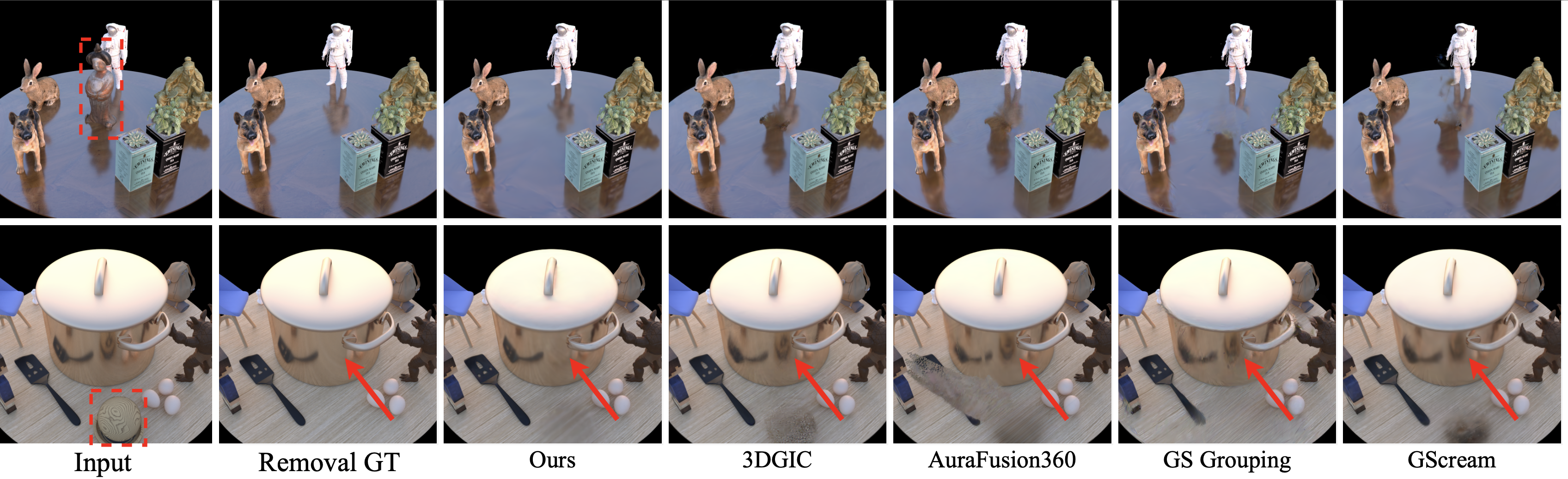
Recent advances in Neural Radiance Fields (NeRF) and 3D Gaussian Splatting (3DGS) have made it standard practice to reconstruct 3D scenes from multi-view images. Removing objects from such 3D representations is a fundamental editing task that requires complete and seamless inpainting of occluded regions, ensuring consistency in geometry and appearance. Although existing methods have made notable progress in improving inpainting consistency, they often neglect global lighting effects, leading to physically implausible results. Moreover, these methods struggle with view-dependent non-Lambertian surfaces, where appearance varies across viewpoints, leading to unreliable inpainting. In this paper, we present 3D Gaussian Object Removal in the Intrinsic Space (GOR-IS), a novel framework for physically consistent and visually coherent 3D object removal. Our approach decomposes the scene into intrinsic components and explicitly models light transport to maintain global lighting effects consistency. Furthermore, we introduce an intrinsic-space inpainting module that operates directly in the material and lighting domains, effectively addressing the challenges posed by non-Lambertian surfaces. Extensive experiments on both synthetic and real-world datasets demonstrate that our framework substantially improves the physical consistency and visual coherence of object removal, outperforming existing methods by 13% in perceptual similarity (LPIPS) and 2dB in peak signal-to-noise ratio (PSNR).
Pipeline
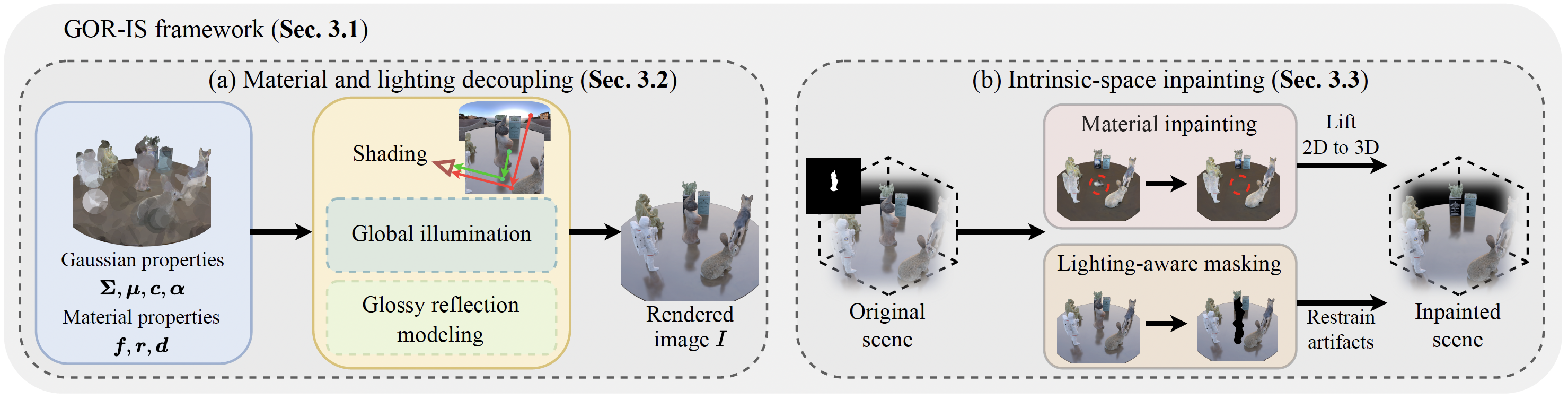
Overview of the GOR-IS framework. We use 3DGS with extended material properties as the basic 3D representation, combined with a global illumination model, to decompose the scene into its material and lighting components. This decomposition enables explicit light transport modeling, ensuring consistent global lighting effects. Furthermore, we introduce a specially designed module for glossy reflection modeling. Building upon this, we propose an intrinsic-space inpainting module to maintain the consistent appearance of scene inpainting. This module includes a material inpainting module that effectively restores non-Lambertian surfaces using view-independent material properties, along with a lighting-aware masking mechanism that suppresses reflection-induced blurry artifacts.
Visual evaluation
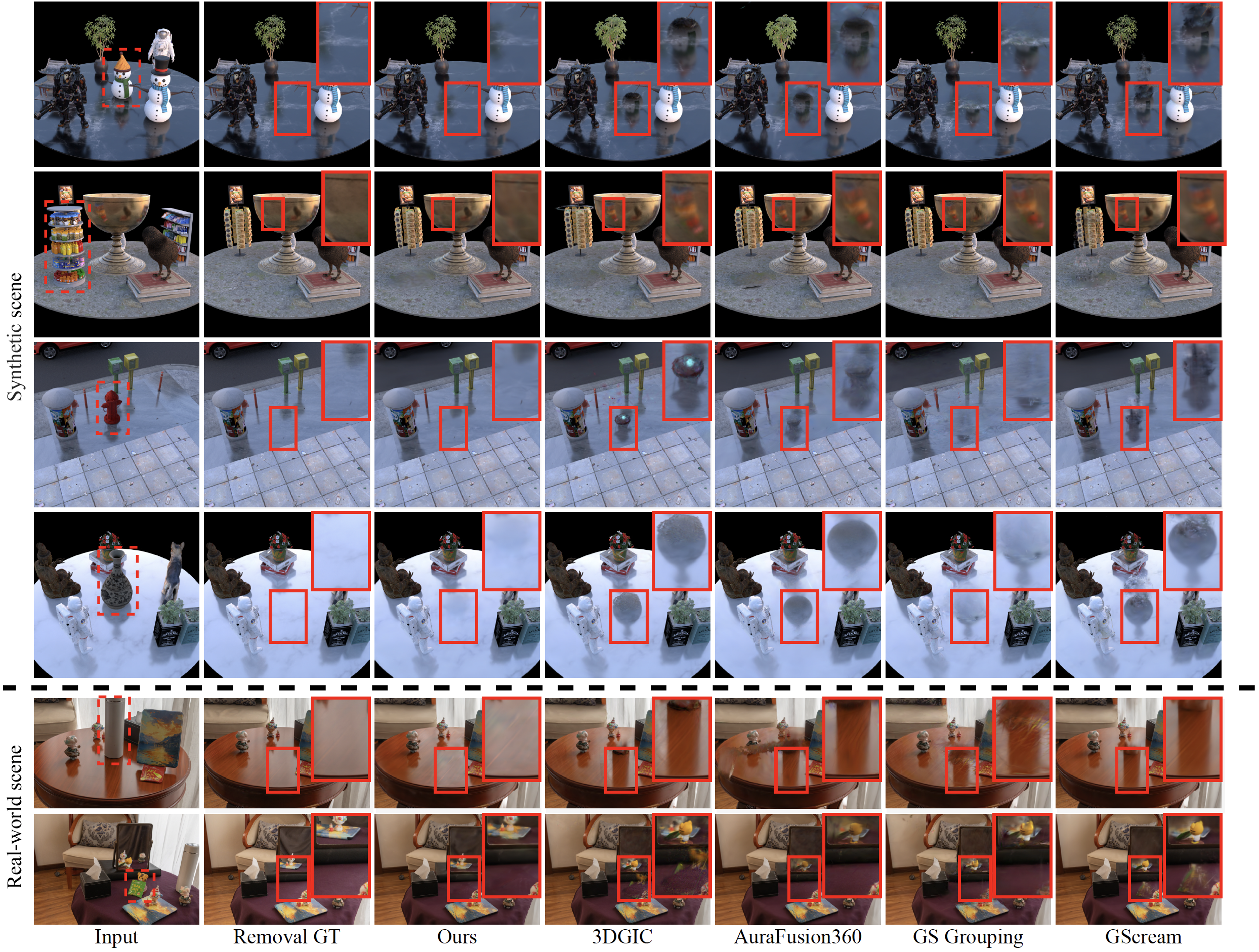
Visual comparisons with baseline methods on the GOR-IS-Synthetic and GOR-IS-Real datasets. Our approach preserves consistent global lighting effects and produces more physically plausible results. Please refer to our paper for quantitative results.
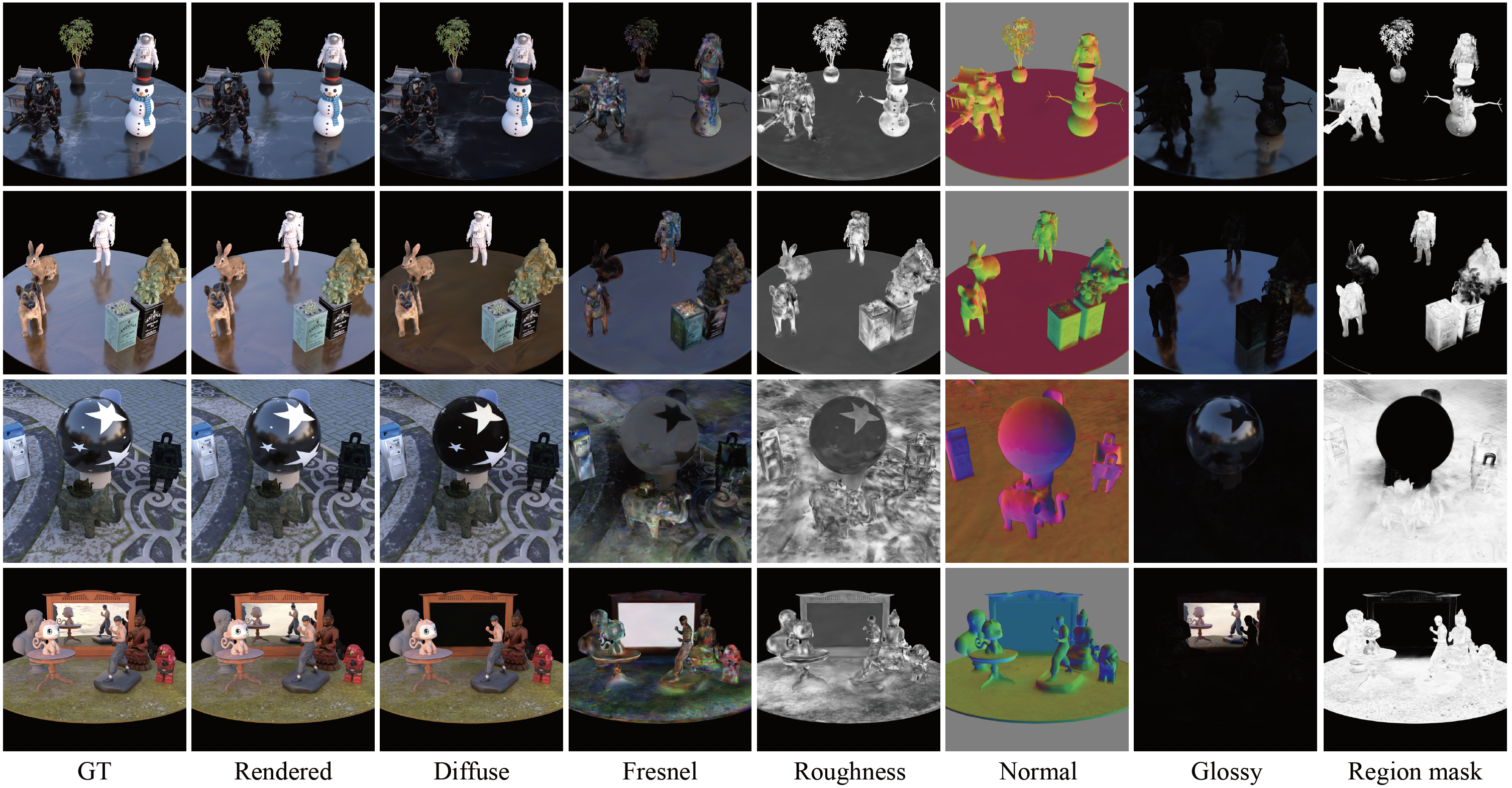
Scene decomposition intermediate results. The visualizations include the ground-truth (GT) images, rendered images, decomposed material properties (diffuse reflection, Fresnel, roughness, and normal), as well as the glossy reflection components and the region masks.
BibTeX
@inproceedings{zhao2026gor-is,
  title={GOR-IS: 3D Gaussian Object Removal in the Intrinsic Space},
  author={Yonghao Zhao and Yupeng Gao and Jian Yang and Jin Xie and Beibei Wang},
  booktitle={Proceedings of the IEEE/CVF Conference on Computer Vision and Pattern Recognition},
  year={2026}
}